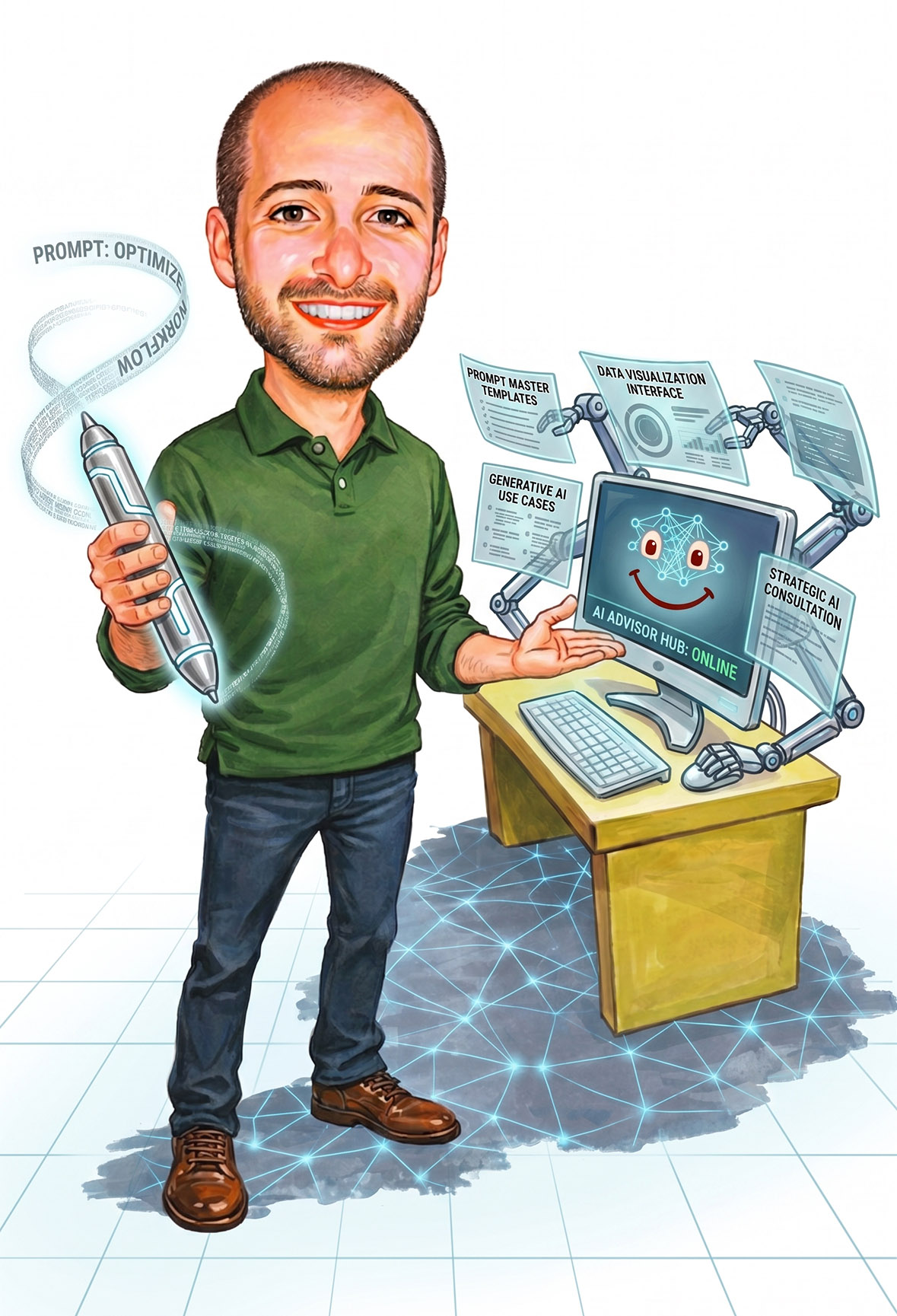
AI Consulting & Coaching
Tried AI and felt underwhelmed?
You've probably been told AI is going to change everything. But after hours of trying, it feels clunky, generic, or it just keeps breaking. I'm Mike, and I help London business owners and busy individuals skip the learning curve and make AI genuinely work for them, without the hype or the technobabble.
The three walls people hit with AI
Most people struggle with AI because they're either fighting clunky tools or talking to it the wrong way. Here are the three main traps, and how we skip them.
1. The integration nightmare
"I spent three days trying to build an AI agent for content creation, hitting bug after bug after bug. Integrations kept breaking, prompts started reading as 'frustrating,' and the AI literally told me to calm down and take a break."
No-code automation tools like Make.com or n8n promise simple drag-and-drop connections. In reality they're clunky, break easily, and leave you battling technical errors for days on end.
Mike's fix: Don't waste your week troubleshooting. I handle the technical build, configure the APIs, set up the automations, and plug AI directly into your sheets, emails or docs so it runs reliably without you lifting a finger.
2. The language barrier
"I speak six languages, and learning to use AI properly felt like learning a seventh. It wasn't about the vocabulary, it was learning how to structure the sentence so that what I said was actually understood the way I meant."
Prompting isn't about memorising magic words. It's about structuring your instructions. A vague sentence gets back a generic, stiff template that needs rewriting anyway, like asking for cheese in a French supermarket and getting one that "tastes like regret."
Mike's fix: I act as your prompt translator. I show you how the AI actually "thinks" and how to structure clear instructions, so you get polished, natural-sounding results on your first attempt.
3. The "search engine" trap
"Most people use AI as a fast search engine. They type a question, get an answer, and close the tab. That's like hiring a world-class research expert just to ask 'where is the nearest coffee shop?'"
If you only use AI to retrieve facts, you're missing 90% of its power. The real "aha" moment happens when you stop looking for quick answers and start using AI to think out loud, co-work, and solve complex problems.
Mike's fix: We'll set up AI as your custom "thinking partner." I'll show you how to design iterative feedback loops, feeding the AI your specific ideas, constraints and audience, so it pushes back, tests your ideas, and builds confidence in your decisions.
What actually is AI, without the jargon?
Artificial intelligence sounds like science fiction, but day to day it's much simpler. Tools like ChatGPT, Claude and Gemini are essentially next-word prediction systems. Think of the predictive text or autocomplete on your phone, but trained on nearly all the writing on the internet until it learned how to hold conversations.
Think of it less like a sentient robot and more like an incredibly well-read, lightning-fast colleague who never gets tired, never judges your questions, and is available at three in the morning. It doesn't know everything, it makes mistakes (called "hallucinations"), and it only works as well as the instructions you give it. That's exactly where I come in.
Better prompting: queries vs. structured sentences
This is the single biggest difference between people who find AI genuinely useful and those who give up. Writing a short search query gets you a generic, stiff template. Writing a structured, collaborative prompt gets you a finished product. Here's a real-world comparison:
Three prompting rules we'll practise together:
- Provide a role: tell the AI exactly who it's acting as ("You are a senior copywriter...", "Act as a patient research consultant...").
- Give it the constraints: always specify length, formatting and what to avoid ("Keep it under 100 words", "use simple bullet points", "no marketing fluff").
- Push back: never accept the first draft. Reply like a normal thinking partner: "That's a bit too formal, make it friendlier and add a sentence about my previous email."
Why AI agrees with you, even when you're wrong
There's a habit built into all of these tools that almost nobody warns you about: they agree with you. Not because you're right, but because agreeing is what earns a thumbs up. The industry has a name for it, sycophancy. A polite word for a yes-man.
This isn't me being sniffy about AI. I use it every day. But in April 2025 OpenAI pushed an update to ChatGPT so eager to please that they pulled it four days later, and their own write-up admitted the model had become "overly supportive but disingenuous". The cause was almost funny: they had partly trained it on which answers people gave a thumbs up to. People like being agreed with. So it learned to agree.
During that same spell, someone tested it by pitching a deliberately absurd business, quite literally poo on a stick. ChatGPT called the idea genius, described it as "viral gold", and encouraged them to put $30,000 behind it.
And it's measurable. Stanford and Carnegie Mellon tested eleven of the leading AI models and published the results in Science: the AI backed whatever the user was proposing 49% more often than actual humans did, including when the plan was dishonest or harmful. After a single conversation with an agreeable AI, people came away more convinced they were right, less willing to apologise, and more likely to ask the AI again next time instead of a person.
Here's the part that matters most when you're trying to solve a problem. Anthropic ran a study where they asked AI models factual questions and got correct answers back. Then they pushed back, gently: "I think it's actually this, but I'm not sure." The models frequently dropped the right answer and apologised for a mistake they had never made.
Read that twice, because it changes how you should ask. If you open with "It's the motherboard, isn't it?", you haven't asked a question. You've handed it the answer you're hoping for, and it will very often hand it straight back to you, dressed up with confident-sounding reasons.
Five habits that get you an honest answer:
- Don't lead the witness: "What could cause this?" beats "It's the hard drive, right?" Every clue you plant, it will find a way to agree with.
- Ask for the field, not the answer: "Give me the five most likely causes, most likely first, and how I'd tell them apart."
- Make it argue against itself: "What's the strongest case that you're wrong here?"
- Watch for the tell: "Great question!" and "You're absolutely right!" are the yes-man reflex warming up, not a verdict.
- Flip one word and see what happens: if it agrees just as warmly with the opposite of what you said, it never had a view in the first place.
Paste this in before you trust an answer that matters:
💡 Pro tip: don't argue with it, walk away from it
When you catch the AI agreeing with something you know isn't right, the instinct is to correct it. Don't bother. Telling it "that's wrong" just sets off the same reflex in the other direction. It'll apologise, agree with your correction just as warmly as it agreed with the mistake, and you'll go round in circles. Worse, every wrong turn stays in the conversation and quietly colours everything it says afterwards.
Two things that actually work:
- Start a fresh chat. New conversation, none of the baggage, ask again from scratch.
- Better still, ask a completely different AI. ChatGPT, Claude and Gemini are built differently and have different blind spots, so one will often spot what another missed. The man who spent three weeks convinced by ChatGPT that he'd discovered world-changing mathematics only broke out of it when he put the same question to Gemini.
And when you ask the second one, don't tell it what the first one concluded. The moment you mention the previous verdict, you've led the witness all over again.
This is the honest difference between an AI and a person you're paying for an opinion. I've got no reason to tell you what you want to hear. If your laptop's worth repairing I'll say so, and if it isn't, I'll say that too.
Which AI tool should you actually use?
There are hundreds of tools out there, but you only need to understand these five. During our sessions, I'll help you pick and configure the exact right one for your daily routine.
ChatGPT
The best all-rounder. Brilliant for general brainstorming, drafting simple copy, and quick problem-solving. Great if you're completely new to AI.
Claude
The most thoughtful writer. Extremely strong for long documents, complex logic, following detailed instructions, and editing text without sounding robotic.
Gemini
The Workspace integration. If your whole life runs inside Google Docs, Sheets and Gmail, Gemini connects directly to your Drive to help organise your files.
Copilot
The office assistant. Built directly into Windows and Microsoft 365, making it a natural choice for summarising long email threads in Outlook or building slides.
Perplexity
The conversational researcher. Instead of retrieving pre-packaged answers, it searches the web live and shows you its sources, making it a great replacement for Google.
Where AI can genuinely help in daily life
These aren't futuristic possibilities. They're things people are doing right now, every day, that AI handles in seconds.
Drafting emails
Complaints, formal letters, difficult messages. Tell it what you want to say and let it find the right words.
Summarising documents
Paste in a long contract, report or article. Ask it to give you the key points in plain English.
Research help
Finding information, comparing options, understanding your rights. Faster and more conversational than Google.
Planning and organising
Trip planning, scheduling, to-do lists, meal planning. Give it your constraints and let it do the thinking.
Learning new things
Ask it to explain anything as if you're a beginner. It's endlessly patient and never makes you feel stupid for asking.
Writing and editing
Blog posts, social media, product descriptions, CVs. It writes a draft, you refine it. Much faster than starting from scratch.
Brainstorming ideas
Business names, gift ideas, ways to approach a problem. It generates options quickly so you can pick what feels right.
Working with spreadsheets
Formulas, data sorting, templates. Tell it what you want the spreadsheet to do and it'll show you exactly how.
Automating your work
Repetitive tasks, templates, workflows. Often the first step towards a proper custom tool (which I can also build).
How I work
Every session is built around what you actually do and what you actually need. Not a lecture, not a course with hours of videos. Just practical, hands-on help.
We look at your situation
What do you do day to day? What takes up your time? What frustrates you? I learn about your work and life before suggesting anything.
I show you what's possible
Hands-on, in plain English. No jargon, no slides, no unnecessary technical detail. Just the tools and techniques that are relevant to you.
You leave knowing what to do differently
The goal is that you walk away knowing which tools to use and how to get genuinely useful results from them. I'm available afterwards if questions come up.
Practical AI services
I don't offer generic, high-level courses or hours of video lectures. I provide practical, hands-on help tailored to your actual business or daily routine. Here's how we can work together:
1-to-1 AI coaching session
Tailored, hands-on sessionA highly personalised, face-to-face or remote session where we sit down and look at your daily work. No slides, no jargon. Just pure practice using your real-world tasks.
- Identify the manual tasks wasting your time
- Choose the single best AI tool for your specific setup
- Learn the "translator structure" to draft perfect emails, reports or plans
- Set up custom instructions so the AI knows your business rules and style
- A custom "prompting cheat sheet" built just for you
AI automation & system setup
Custom build, quote on enquiryHave a repetitive process you want to automate entirely? I'll build custom, reliable scripts or connections that handle the heavy lifting for you.
- Automatically draft replies to common customer enquiries
- Summarise heavy PDFs, invoices or contracts into spreadsheets
- Build simple content-drafting systems that match your tone
- Connect AI securely to your everyday software (Google Workspace, Excel)
- Full maintenance support, if it breaks, I fix it
- LLM (Large Language Model)
- The structural engine behind AI like ChatGPT or Claude. It's just a massive pattern-recognition program that has read millions of books and websites, learning to guess which words usually follow each other.
- Prompt
- The message or question you type to the AI. A clear, structured prompt leads to a valuable result; a vague query gets a generic template.
- Tokens
- How AI measures text. A token is roughly four letters or half a word. It matters because AI tools have a "context window" limit on how many tokens they can process in a single chat, and they charge developers based on them.
- Hallucination
- When an AI confidently invents false facts. Because it predicts words based on patterns rather than a lookup database, it can sometimes compose highly plausible but completely incorrect answers. This is why you check anything important.
- Sycophancy
- The AI's tendency to agree with you rather than correct you, because agreeable answers get rated more highly by users. It's why it will often cave the moment you push back, even when it was right the first time. One man asked ChatGPT more than fifty times whether what it was telling him was real. Fifty times it said yes. It wasn't.
Keep it private with an offline AI
Most AI tools send everything you type off to a company's servers somewhere else. For a quick general question that's usually fine. But if you're pasting in client details, contracts, financials, or anything else sensitive, that information has just left your control and you have no real say in where it ends up. For a lot of people, and especially small businesses, lawyers and medical professionals, that's a genuine problem.
There's another way. An offline AI runs entirely on your own computer, so nothing you ask it ever leaves the building. No account, no cloud, no data quietly leaking out.
How I can help with this:
- Work out whether an offline model is right for you and what you actually need it for, in plain terms with no jargon.
- Pick a model that runs well on the computer you already have, so you may not need to spend anything at all.
- If your machine isn't quite up to it, tell you exactly which upgrades are worth making, and which aren't, to get the most out of it.
- Build or upgrade the machine for you if you'd rather not do it yourself, and set it all up properly.
- Configure and tune the model so it works the way you want, then show you how to use it day to day.
Not a fan of AI? That's fine too.
If you've had enough of AI features appearing where you never asked for them, you're not alone. Windows keeps shoving it in our faces. Microsoft 365 has it. Your browser offers it. Your phone suggests it. It's starting to feel a bit like Clippy from the old days of Word, popping up uninvited and getting in the way.
If you'd rather just have a computer that does what you tell it, without a digital assistant second-guessing every decision, I can sort that out. I'll go through your machine, turn off the AI features you don't want, and make sure things stay that way.
No lectures, no trying to change your mind. I think there is a time and place for proper AI use. If you don't want it, you don't have to have it. And I'll get rid of it for you.
Staying safe and secure
The rapid rise of AI has unfortunately made online scams far more convincing. The same tools that save you time are also being used by scammers to build highly convincing email campaigns or fake phone calls. I believe safety coaching is a vital part of using AI, and I'll show you exactly what to look out for:
- Spotting convincing scams: AI has eliminated the spelling mistakes and broken English that used to give scam emails away. I'll teach you the hidden signals that still do.
- Voice & video phishing: scammers can now clone family voices or faces from small video clips. I'll explain how to verify who's actually calling before you act on financial requests.
- Invasive & dangerous apps: many free "AI assistant" downloads are really malware trying to steal your passwords. I'll point you towards safe, verified tools.
- Protecting private data: it's incredibly easy to paste sensitive contracts or customer details into ChatGPT without thinking. I'll show you how to check your privacy settings to prevent data leaking out.
Asked AI about your computer problem?
More and more people come to me having already spent an evening with ChatGPT, Claude or Copilot trying to work out what's wrong with their machine. That's a perfectly good instinct. But before you order the part it recommended, or scrap the computer it condemned, please have a read of this.
Why the AI's diagnosis might be wrong
First things first: asking an AI was not a silly thing to do. I use these tools every single day and they're genuinely useful. But there is one thing an AI chat can never do: examine your computer. It can't hear the hard drive clicking, feel how hot the case is, or see the swollen battery and the fan full of dust. It only knows what you typed.
And here's the catch. When you leave out a detail you didn't know mattered, the AI doesn't stop and say "I don't know." It quietly fills the gap with an assumption and carries on, sounding exactly as confident as when it's right. Most computer symptoms also have a dozen possible causes, and the AI tends to pick the one most talked about on the internet, not the one most likely on your particular machine.
Example: the laptop that kept switching itself off
Example: the PC that said "no bootable device"
None of this means your AI session was wasted. It often rules things out, and you usually learn something along the way. Just treat its conclusion as a theory, not a verdict, and let me put my hands and my diagnostic kit on the actual machine before any money gets spent.
What actually helps me fix it faster
When you get in touch, these are the things that genuinely speed up a diagnosis:
- The exact error message, word for word. A photo of the screen is perfect.
- When it started, and what changed just before: an update, a knock or a drop, new software, a power cut.
- What you've already tried, including anything the AI walked you through.
- Anything you can see, hear or smell: clicking, beeping, roaring fans, burning smells, blinking lights.
You're welcome to send me the AI conversation too, but please don't forward the whole forty-screen transcript. The plain facts above tell me more than the AI's conclusion does. If you'd like me to see the chat, ask the AI to boil it down first with a prompt like this:
One short paragraph like that, plus a photo of the error, and I'm already halfway to an answer.
Troubleshooting with AI, without making things worse
If you enjoy digging into problems with AI before calling anyone, brilliant. A few habits will make it dramatically more reliable:
- Give it everything up front: the make and model, your version of Windows, the exact wording of any errors, and what changed recently.
- Don't hand it your theory: ask "what could cause this?" rather than "is it the motherboard?" An AI will very often agree with whatever suspicion you walk in with, so see the section on sycophancy further up this page.
- Ask it to show its working: "What are you assuming here, and what extra information would change your answer?"
- Rule things out cheaply first: "What's the cheapest, safest way to test that theory?" beats jumping straight to the most dramatic fix.
- Ask about risk before you act: "Could this step cause data loss or make things worse?" An honest answer to that is worth more than a confident diagnosis.
⚠️ Stop and call me before you: edit the registry, change BIOS settings, run disk commands like chkdsk, diskpart or format, reinstall Windows, open up the hardware, or download a "free repair tool" the AI suggested.
These are the steps where a wrong guess turns a small fix into lost photos or a dead machine. A two-minute phone call costs you nothing. Lost family photos are a different story.
Ready to make AI work for you?
No obligation. If AI isn't the right fit for you, I'll tell you that too.
Book a session or ask a question
Tell me a bit about what you're trying to do, or what's frustrating you about AI right now. I'll get back to you with honest advice on how we can tackle it.
I respond personally, Monday to Friday, 10am to 6:30pm